HOW CAN AGRICULTURE SURVIVE
IN
SOUTH AFRICA
NO-TILL (MINIMUM TILLAGE) - SPECIALIZED CO-OPERATIVE FARMING - PRECISION FARMING
NO-TILL (MINIMUM TILLAGE) - SPECIALIZED CO-OPERATIVE FARMING - PRECISION FARMING
Stes
de Necker
Introduction
In
2004 it was already evident that South Africa’s land reform policies were not
achieving its socio- economic objectives. The uncoordinated and sometimes
haphazard funding of agricultural related projects failed to achieve the
economic growth needed in this sector of the economy.
These
unsuccessful policies, coupled with the increased economic demands on the
agricultural sector, resulted in failed land reform and agriculture related
development projects throughout South Africa. Numerous once productive and
vibrant farming enterprises are currently little more than unproductive
wasteland.
The Political
Landscape of the South African Agricultural Sector
Away
from the resources and energy of the main agricultural producing areas of South
Africa, polite political expressions of loyalty, poor service delivery and
sheer incompetence seems to be the order of the day.
Creative
and effective participation in the global economy, by all farmers in the
agricultural sector, requires an entirely different mindset – a mindset that
dares to be less governmental, that challenges conventional development
policies and foster competitive regional and global linkages.
With
the best intentions in the world, present South African Government policies,
mentorships, NGO’s and commodity organizations have at best only succeeded in
the establishment of a few subsistence farming operations. These efforts are
doomed to failure unless a long term remedy can be found to stop the continuous
decline in economically viable agricultural production.
Nowhere
in modern history has governments been able to conduct farming operations
economically and sustainable within the confines of rigid governmental policies
and statutory regulations. Communist Russia, Cuba and most recently Zimbabwe
are prime examples of this incapacity. Numerous regimes in the rest of Africa
have also failed to effectively produce food for their citizens.
Inadequate
agricultural development policies coupled with constant rising input costs and
the accompanying inability of many farmers to maximize revenue in the market
place, have forced many farmers off their land.
Furthermore,
the majority of South African farmers, especially emerging and existing small
to medium scale farmers, are unable to stay abreast of modern scientific
methodology and technology due mainly to financial constrains and inadequate
support structures.
The
proportional contribution of the agricultural sector to the Free State’s GGP
has shown a constant annual decline since 2000. This decline has resulted in a
net loss of some 175,000 jobs during the period 2000 – 2009. The biggest threat
to future food security in South Africa is the current exodus of farmers from
the agricultural sector due to economic pressures.
Countries
like Brazil, The Ukraine and China have largely converted to new generation
fuel efficient tractors and farming equipment. Combined with modern production
methods like for example scientific minimum tillage and water harvesting
techniques, this change-over not only made it possible for many established
farmers to survive the international economic pressures on agriculture, but
also to increase their production and profitability. In South Africa the only
successful farmers are those who are applying modern scientific methodologies
and technologies in order to ensure their eventual success.
As
a result of stable government and disciplined macro-economic policies, South
Africa has managed to hang on to the international mainstream economy since
1994. This is however proving to be increasingly more difficult. Greater
efficiency in terms of government service delivery, increased productivity and
economically productive investment is critically necessary.
Should
South Africa loose further ground in competing in the international economic
arena it would most certainly join the likes of Zimbabwe, Myanmar, North Korea
and Somalia as the failed states of the recent world order. South Africa faces
real and possible ejection from the first world economy to a position of a
typical third world economy. This could happen sooner rather than later.
Opportunities
In
the Free State Province of South Africa, prime arable land is currently
available in the former self governing and independent homeland areas.
Approximately 85 000 hectares of which at least 80% is available for food
production, currently lies underutilized, for example in the former
Bophuthatswana homeland area.
Farming
operations after 1994, have become obsolete and uneconomical.
Post
1994 however, with the incorporation of these areas in a single united South
Africa, these farmers no longer received the financial support on which they
had become dependent. The result was that most farming operations in these
areas, especially capital intensive operations such as production of grain
crop, came to a sudden halt.
Pre
1994, substantial returns were produced on these lands with the help of the
highly subsidized programmes of the then Bophuthatswana Government. This vast
potential could, with the necessary management in best practice methodologies,
again be harnessed into food production, effectively reducing the previously
mentioned decline.
The
increasing application of modern crop rotation systems, the development of new
technology and the application of new tillage methodologies are rapidly
creating vast new possibilities to solve the problems experienced with previous
orthodox farming practices.
New
generation tractors and implements designed primarily with a view to maximize
fuel efficiency and optimal kilowatt ratios further reduce input costs
significantly.
Modern
cultivation methods, the availability of modern day precision farming models
and technology, the advantages of specialized co-operative farming and the
availability of large areas prime arable land, which have for more than a
decade not been utilized for crop production, have presented what is certainly
the biggest opportunity for profitable crop production in South Africa today.
With
the application of sound financial and farming practices, scientifically proven
best practices and new generation cost effective farming implements and
technology, large areas of prime agricultural land, which once produced vast
quantities of cash crops, can again become one of the major grain producing
areas in the Republic.
The modern science
of 'no-till' or minimum tillage
No-till
cropping is a relatively new science in crop production, based on the principal
that planting is done with the least possible disturbance of the natural soil.
The
traditional practices of ploughing and tilling of the soil before planting,
destroy the natural soil organisms and leave the soil unprotected to
evaporation, wind erosion and flood damage.
The
science of no-till, on the contrary, utilizes the natural soil organisms to
promote seed germination and plant growth while protecting the soil against
erosion and flood damage, at the same time limiting unnecessary evaporation of
the moisture in the soil.
90
% of all maize production in Brazil is done today by way of the no-till system
and increased yields of up to 30 % have been recorded in parts of that country.
Over
and above higher yields in production, the system of no-till also saves up to
45% on fuel costs as well as machinery and equipment costs, because implements
need only to move over a specific land area at the most three times as compared
to the 5 or 6 times in the case of conventional cultivation.
Conventional crop production usually involves regular tilling with tractor-drawn implements that agitates the soil in various ways. Tilling is used to remove weeds, mix in soil amendments like fertilizers, shape the soil into rows for crop plants and furrows for irrigation, and prepare the surface for seeding. This can lead to unfavorable effects like soil compaction, loss of organic matter, degradation of soil aggregates, death or disruption of soil microbes, arthropods and earth worms, and soil erosion where top soil is blown or washed away. No-till farming avoids these unfavorable effects by reducing or excluding the use of conventional tilling.
Research has shown that repeated tillage destroys the soil resource base and causes adverse environmental impact. Tillage degrades the fertility of soils, causes air and water pollution, intensifies drought stress, consumes fuel, and contributes to global warming. Farmers today are expected to produce food in ever greater quantities. This is becoming more difficult to do in view of declining soil quality which can be caused by soil tillage. It is becoming well known that no-till is an effective technique to reduce the degradation of soil. With this way of farming, crop residues or other organic matter are retained on the soil surface and planting and fertilizing is done with minimal soil disturbance.
A major obstacle that farmers often face with change to continues no-till is overcoming yield-limiting factors during the transition years, that is, the first years of no-till following a history of intensive conventional tillage. These factors are often poorly understood and are usually biologically driven. Some of the problems involve residue management and increased weed and disease infestations.
Experience seems to indicate that many problems during the transition phase are temporary and become less important as the no-till system matures. The judicious use of crop rotations, cover crops and limited soil disturbance may help reduce agronomic risks during the transition years. Farmers switching to continues no-till must often seek new knowledge and develop new skills and techniques in order to achieve success with this different way of farming.
Further research into these techniques is urgently needed to provide strategies for promoting no-till as a way to enhance agricultural stability in South Africa.
Effects on soil
In No-till farming the soil is left intact and crop residue is left on the field. Soil layers, and in turn soil biotics are therefore conserved in their natural state. Variations of the conservation tillage method may involve some working of the soil with attention paid to keeping soil compactation and carbon loss at a minimum. These variations include reduced tillage, i.e. strip-till, in which small strips may be tilled to allow space for planting seeds.
Strip-tillage is primarily used in areas where the soil profile contains a natural hard pan that creates a barrier preventing plant roots from moving deeper into the soil profile to access water and nutrients. Strip-tillage also creates a more suitable seed bed for crops where the harvestable portion is produced below the surface such as peanuts.
Pros and cons
There are advantages and disadvantages to no-till and minimum tillage systems.
No-till has carbon retention potential through storage of soil organic matter in the soil of crop fields. Conventional methods cause the soil layers to invert, air mixes in, and soil microbial activity dramatically decreases. The result is that soil organic matter is broken down much more rapidly and carbon is lost in the form of carbon dioxide into the atmosphere. This, in addition to the emissions from the farm equipment itself increases carbon dioxide levels in the atmosphere.
Cropland soils are ideal for use as a carbon sink since it has been depleted of carbon in most areas. Conventional farming practices that rely on tillage, have removed carbon from the soil ecosystem by removing crop residues such as left over maize stalks, and further through the addition of chemical fertilizers which also have the above mentioned effects on soil microbes.
By reducing tillage and leaving crop residues to decompose where they lay, field carbon loss can be slowed and eventually reversed.
Further benefits
Other benefits of no-till include increasing soil quality {soil function}, protecting the soil from erosion, evaporation of water, and structural breakdown. Crop residues left intact help both natural precipitation and irrigation water to infiltrate the soil where it can be used. The crop residue left on the soil surface also limits evaporation and conserving water for plant growth. The reduction in the number of times equipment move over the field helps prevents the compaction of soil.
Less tillage of the soil reduces labour and related fuel and machinery costs. Less soil ploughing means less airborne dust which is a serious pollutant in some agricultural areas. No-till fields often have more beneficial insects and annelids {earthworm}, a higher microbial content, and a greater amount of soil organic material.
Disadvantages
Yield
Yields are often immediately impacted negatively by inexperienced no-till farmers. A combination of technique, equipment, pesticides, crop rotation, fertilization, and irrigation has to be found which is optimal for the area-particular conditions. However, excluding the need to till, and organize the soil into contours and drainage ditches is often sighted as increasing profit by reducing cost and labour, even with an initial diminished yield.
A problem that farmers may face is that in the spring the soil will take longer to warm and dry which may stall planting to a less ideal future date. One reason why the soil is slower to dry is that the field absorbs less solar energy as the residue covering the soil is a much lighter color than the soil which would be exposed in conventional tillage.
With no-till, residue from the previous year’s crops lying on the surface of the field, may have the potential of harboring pathogens. This may lead to a higher level of disease in the crop than that of an intensively tilled field.
Equipment
A primary disadvantage of no-till farming is the need for specialized planting equipment designed to plant seeds into undisturbed soil and crop residues. Fortunately today many types of no-till planters are readily available.
Chemicals
One of the purposes of tilling is to remove weeds. No-till farming changes weed composition drastically. Faster growing weeds may no longer be a problem in the face of increased competition, but shrubs and even trees may begin to grow eventually. This problem can however be solved by using a more aggressive herbicide and because of this, no-till is often associated with increased chemical use in comparison to traditional tillage based methods of crop production.
Crop rotation is also more important in no-till farming as soil conditions change. Some no-till farmers utilize a wide variety of crop cycles to exploit their particular soil condition and weed situation for maximum yields.
Erosion
While considerably less soil is displaced through no-till, drainage gullies that do form may get deeper every year instead of disappearing. This may necessitate either sod drain ways or permanent drain ways in extreme circumstances. Because no-till farming often causes a slight increase in soil bulk density there is a misconception that periodic tillage is necessary to “fluff” the soil back up. In countries like Brazil where millions of hectares of land have been no-tilled for over 20 years, water infiltration, biologic activity, soil aggregate stability, and productivity have all increased well beyond traditionally tilled land.
No-till farming mimics the natural conditions under which most soils formed; more so than any other method of farming in that the soil is left undisturbed except to place the seed in a position to germinate.
Summary
Comparison between conventional and no-till systems summarized.
Conventional systems
|
No-till
|
1. Soil tillage is necessary to produce a crop
|
1. Tillage is not necessary for crop production
|
2. Burying of plant residues with tillage implements
|
2. Crop residues remain on the soil surface as mulch
|
3. Bare soil for weeks and months
|
3. Permanent soil cover
|
4. Soil heating because of direct solar radiation
|
4. Reduced soil temperatures
|
5. Burning crop residues allowed
|
5. Burning mulch prohibited
|
6. Strong emphasis on soil chemical process
|
6. Emphasis on soil biological processes
|
7. Chemical pest control first option
|
7. Biological pest control first option
|
8. Green manure cover crops and crop rotations are options
|
8. Green manure cover crops and crop rotations compulsory
|
9. Soil erosion is accepted as an unavoidable process associated to farming on sloping land
|
9. Soil erosion is merely a symptom cause by soil mismanagement
|
Consequences of soil preparation and bare soil
|
Consequences of no-tillage and permanent soil cover
|
1. Wind and water erosion are unavoidable
|
1. Wind and water erosion near zero
|
2. Reduced water infiltration into the soil
|
2. Increased water infiltration into the soil
|
3. Less available soil moisture
|
3. More available soil moisture
|
4. Unavoidable reduction in the soil organic matter content thus reduction of soil quality
|
4. Maintenance or increase in the soil organic matter content [enhancement of soil quality
|
5. Soil carbon is lost as carbon dioxide into the atmosphere
|
5. carbon is retained in the soil enhancing its quality
|
6. Reduction of crop productivity
|
6. Crop productivity increase
|
7. Higher use of fertilizers and higher cost of production
|
7. Reduced use of fertilizers and lower production costs
|
8. Poverty, rural exodus increase of informal settlements and social conflict
|
8. Basic needs are satisfied, living standard and quality of life of farm families increased and depopulation of rural areas restricted and or even reversed
|
Off farm effects of soil erosion
|
Off farm effects of no-till
|
1. Sedimentation of rivers, reservoirs, dams and micro catchments
|
1. Reduction of sedimentation of rivers, reservoirs, dams and micro catchments
|
2. Reduced water quality
|
2. Enhanced water quality
|
3. Higher cost for government and for society due to the effects of soil erosion
|
3. Reduction of cost for government and society due to limited effects of soil erosion
|
Specialized
co-operative farming
Modern
specialized co-operative farming is successfully practiced by New Zealand and
Irish Agriculturalists. Having been faced by grave financial difficulties in
the 1980s, they realized that for farming to survive those challenges, farmers
would have to change the traditional practices of subsistence farming and
farming being a way of life, to that of commercial and business orientated
farming.
Cooperative farming must not be confused with communal farming systems being practiced in certain parts of the world. The well known Kibbutz system practiced in Israel
Cooperative Farming differs considerably from communal farming in the sense that separate farming operations, jointly, form a cooperative, each with its own responsibility within a chain of agricultural production.
The concept of cooperative farming, originated primarily in New Zealand in the late 1980’s, when the then Government of New Zealand virtually handed political power over to the opposition in the 1986 election.
At that stage, NZ was for all intense and purpose bankrupt, and the newly elected government inherited an economically devastated society. Many civil servants were retrenched and serious cutbacks in the country’s national budget had to be effected.
Not being in a the fiscal position to effectively support the New Zealand agricultural sector any more, organised agriculture approached the NZ Government with the proposal that should the government relinquish all unnecessary controls over the agricultural sector, the farming community of NZ will organize and regulate themselves in a system, which they believe, can restore the economic decline in the agricultural industry. The only government support they required, was for the NZ Government to protect the agricultural sector against foreign economic threads like dumping, subsidization, restrictive exchange controls etc.
Up to 1986, New Zealand used to be a nett importer of basic agricultural produce, Millions of Rands of dairy products, meat, poultry and grain were imported from South Africa
The NZ farmers came to agreement to work together in a system of specialized cooperative farming, where each farming enterprise undertook to specialize in a particular facet of the agricultural process.
In dairy farming, the system of specialized cooperative farming required that a farmer whose farming operation is best suited for pasture development, will revert to the establishment of, exclusively, pasture grazing, while a second farmer who may be better equipped for animal husbandry, will concentrate on rearing the most productive cows for milk production.
A third entity, separate from both the above, will concentrate on the most scientific milking practices and systems as well as the distribution of fresh milk and value adding. This meant that all three operations could be shared by three distinct farming enterprises, each one with its own identity and responsibility.
This system made it possible that the cattle owner, scientifically breed and develop his cow stock, allow it to graze on the pasture owner’s lands, which in turn was scientifically developed by the pasture owner to render optimal growth and nutritional value, and have the cows milked at the milking facility, which specializes in best practice milking procedures and fresh milk distribution.
A fourth, value adding component, who specializes in secondary dairy manufacturing like for instance powdered milk, yogurt, cheese, butter etc. is responsible for this function in the value adding chain.
The same principles were also applied in beef and poultry production, where the livestock owner, grazing pasture/ broiler facility owner, abattoir, and meat/egg processing facility, each operated as a separate profit centre.
Also in cash cropping and vegetable farming, the land owner from whom the fields are rented, the owner of the tractors and implements required for crop production, the crop owner, milling and distribution and secondary food production such as vegetable oils, margarine, cereals etc. all functioned as separate profit centres.
This system of specialized cooperative farming enabled the NZ agricultural industry to move, in a period of no less than fifteen years, from a position of nett importer to nett exporter of agricultural produce.
Communal farming is nothing new to the African people and in most Africa regions, communal farming is the accepted rule rather than the exception.
Until very recently, Africa had a very strong feudal system of land ownership. Rural land belonged to a Chief, who in turn allocates certain portions thereof to feudal land dwellers who cultivates the land.
Even today, most of the land which belonged to the former TBVC areas, (Transkei , Bophuthatswana , Venda and Ciskei
Precision Farming
Modern
advanced computer systems and GPS technology, has made it possible to perform
farming operations must more cost effectively than in the past. With the proper
application of these technologies, savings in production input costs of up to
35% can be achieved.

Just as industrial manufacturing has changed radically over the last century, farming also need to change. The classic example of the farming being a way of life is long outdated. Farming has become a business which must be conducted on sound business practices. Costs, technology and economies of scale have forced most commercial farms around the world to change. And precision farming is beginning to play an ever increasing role in the quest for survival in the agricultural sector.
Topography and boundaries
Several benefits are achieved from an automated method of capturing, storing and analyzing physical field records. Detailed analyses of the farm production management activities and results can be carried out. Farmers can look at the performance of new varieties by site specific area, measure the effect of different seeding dates or depths and show to their banker the actual yields obtained and the associated risk levels. It is imperative that trends and evaluations are also measured over longer time spans. Cropping strategies to control salinity for instance, may take several years to evaluate while herbicide control of an annual weed should only take one season.
Precision farming makes farm planning both easier and more complex. There is much more map data to utilize in determining long term cropping plans, erosion controls, salinity controls and assessment of tillage systems. But as the amount of data grows, more work is needed to interpret the data and this increases the risk of misinterpretation. Farmers implementing precision farming will likely work closer with several professionals in the agricultural, electronics and agricultural equipment manufacturing sectors.
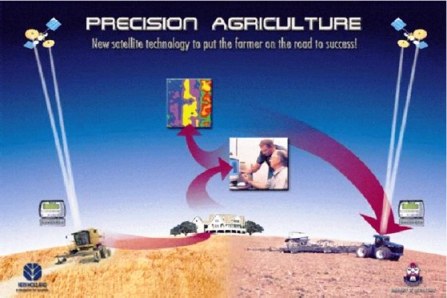
Precision farming integrates a number of technologies in order to optimize the benefits of mechanization, which is so essential for effective food production. By using satellite data to determine soil conditions and plant development, these technologies can lower the production cost by fine-tuning seeding, fertilizer, chemical and water use, and potentially increasing yield production and lowering costs — all benefiting the farmer. In turn, precision agriculture may have significant impacts far beyond the individual farm. Pollution is a common problem stemming from agricultural practices.
Excess agricultural chemicals must go somewhere, and somewhere frequently means the common environment. Agricultural chemicals which may play a vital role in agricultural production, may well be considered pollutants once it has reached the common environment.
Excess agricultural chemicals must go somewhere, and somewhere frequently means the common environment. Agricultural chemicals which may play a vital role in agricultural production, may well be considered pollutants once it has reached the common environment.
At its heart, the application of precision agriculture requires two spatial requirements:
(1) Concurrent knowledge of where the farm equipment is at any given time, and
(2) The value of one or more variables as a positioning function within a given field.
These variables requirements two sets of information; the “where” and the “what.”
Spatial precision needed for “where” varies from a few meters to a few centimeters, that can be satisfied by GPS, data processing systems. In fact, using real-time GPS, it is possible to guide farming equipment to stay along a track of hundreds of meters long with only centimeter-scale deviations.
The second requirement, the “what,” is where remote sensing comes into the picture.
The electronics revolution of the last decades has spawned two technologies that will impact agriculture in future. These technologies are Geographic Information Systems (GIS) and Global Positioning System (GPS). Along with GIS and GPS there have appeared a wide range of sensors, monitors and controllers for agricultural equipment such as shaft monitors, pressure transducers and servo motors. Together they will enable farmers to use electronic guidance aids to direct equipment movements more accurately, provide precise positioning for all equipment actions and chemical applications and analyze all of that data in association with other sources of data (agronomic, climatic, etc). This will add up to a new and powerful management tool for the progressive farm manager.
Just as industrial manufacturing has changed radically over the last century, farming also need to change. The classic example of the farming being a way of life is long outdated. Farming has become a business which must be conducted on sound business practices. Costs, technology and economies of scale have forced most commercial farms around the world to change. And precision farming is beginning to play an ever increasing role in the quest for survival in the agricultural sector.
Precision farming should not be thought of as only yield mapping and variable rate fertilizer application and evaluated on only one or the other. Precision farming technologies will affect the entire production function (and by extension, the management function) of the farm. It is not only about an abstract measurement or characterization. It is about specific values at exact locations, assisting the farmer.
Precision farming will result in an explosion in the amount of records available for farm management. Electronic sensors can collect a lot of data in a short period of time. Lots of computer storage space is needed to store all the data as well as the map graphics resulting from the data. There are currently a number of electronic controllers which will record data electronically.
It is necessary that fertilizer rates actually put down by the application equipment, is according to the requirements of the actual needs recorded by a prescription map. A lot of new data is generated every year (yields, weeds, etc). Farmers will want to keep track of the yearly data to study trends in fertility, yields, salinity and numerous other parameters. This means a large database is needed with the capability to archive, and retrieve data for future analyses.
Yield monitoring.
Instantaneous yield monitors are currently available from several manufacturers for all recent models of combines. It provide a crop yield by time or distance (e.g. every second or every few metres). It also track other data such as distance and tonnage per load, number of loads and fields. Yield mapping GPS receivers coupled with yield monitors provide spatial coordinates for the yield monitor data. This can be made into yield maps of each field. Variable rate fertilizer variable rate controllers are available for granular, liquid and gaseous fertilizer materials. Variable rates can either be manually controlled by the driver or automatically controlled by an on board computer with an electronic prescription map.
Weed mapping
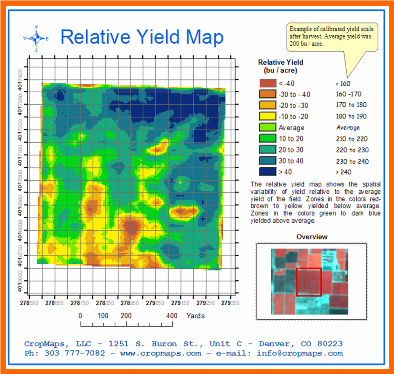 |
| Yield mapping during harvesting |
Weed mapping
A farmer can map weeds while combining, seeding, spraying or field scouting by using a keypad or buttons hooked up to a GPS receiver and data-logger. These occurrences can then be mapped out on a computer and compared to yield maps, fertilizer maps and spray maps. Variable spraying by knowing weed locations from weed mapping spot control can be implemented. Controllers are available to electronically turn booms on and off, and alter the amount (and blend) of herbicide applied.
Topography and boundaries
Using high precision GPS a very accurate topographic map can be made of any field. This is useful when interpreting yield maps and weed maps as well as planning for grassed waterways and field divisions. Field boundaries, roads, yards, tree stands and wetlands can all be accurately mapped to aid in farm planning.
Salinity mapping GPS can be coupled to a salinity meter sled which is towed behind an ATV (or pickup) across fields affected by salinity. Salinity mapping is valuable in interpreting yield maps and weed maps as well as tracking the change in salinity over time.
 |
| Topography mapping of a field |
Salinity mapping GPS can be coupled to a salinity meter sled which is towed behind an ATV (or pickup) across fields affected by salinity. Salinity mapping is valuable in interpreting yield maps and weed maps as well as tracking the change in salinity over time.
Guidance systems
Several manufacturers are currently producing guidance systems using high precision DGPS that can accurately position a moving vehicle within a foot or less. These guidance systems may replace conventional equipment markers for spraying or seeding and may be a valuable field scouting tool.
 |
| The "layerd" approach. Looking at a three dimensional analysis of a field |
Several benefits are achieved from an automated method of capturing, storing and analyzing physical field records. Detailed analyses of the farm production management activities and results can be carried out. Farmers can look at the performance of new varieties by site specific area, measure the effect of different seeding dates or depths and show to their banker the actual yields obtained and the associated risk levels. It is imperative that trends and evaluations are also measured over longer time spans. Cropping strategies to control salinity for instance, may take several years to evaluate while herbicide control of an annual weed should only take one season.
Precision farming should be approached in stages, in order to ease into a more complex level of management. Precision farming does not "happen" as soon as one purchases a GPS unit or yield monitor. It occurs over time as a farmer adopts a new level of management intensity on the farm.
Implicit in this is an increased level of knowledge of the precision farming technologies such as GPS and GIS. What is perhaps more important for the success of precision farming, at least initially, is the increased knowledge that a farmer needs of his natural resources in the field. This includes a better understanding of soil types, hydrology, microclimates and aerial photography. A farmer should identify the variance of factors within the fields that effect crop yield before a yield map is acquired. A yield map should serve as verification data to quantify the consequences of the variation that exists in a field. Management strategies and prescription map development will likely rely on sources other than yield maps. The one important key source of data a farmer should not start precision farming without an aerial photograph.
 |
| Satellite image of a production field |
Precision farming makes farm planning both easier and more complex. There is much more map data to utilize in determining long term cropping plans, erosion controls, salinity controls and assessment of tillage systems. But as the amount of data grows, more work is needed to interpret the data and this increases the risk of misinterpretation. Farmers implementing precision farming will likely work closer with several professionals in the agricultural, electronics and agricultural equipment manufacturing sectors.
Precision farming is ideally suited for improved economic analyses. The variability of crop yield in a field allows for the accurate assessment of risk. For example, a farmer could verify that for 70 % of the time, 75 % of the maize grown in field "A" will yield X ton per hectare. By knowing the cost of inputs, farmers can also calculate return over cash costs for each square meter of the field. Certain parts of the field which always produce below the break even line can then be isolated for the development of a site-specific management plan.
Precision farming allows the precise tracking and tuning of production.
 |
| Knowing your exact profit or loss per hectare |
Precision farming allows the precise tracking and tuning of production.
The Key
requirements for success
From
a survey that was conducted amongst some of South Africa’s most successful
commercial farmers and those who had to cease their farming operations due to
bankruptcy, it became evident that in order to survive in the modern
agricultural industry, not only in South Africa but worldwide, farmers need to
be in full command of at least the following seven key requirements to
remain successful viz:
2.1
They
must be in possession of good productive land
2.2
They
must be in a position to utilize modern cost effective and technologically
advanced equipment
2.3
They
must have a thorough knowledge of advanced scientific farming practices and
processes
2.4
They
must have a thorough knowledge of and access to modern financial methods and
practices
2.5
They
must have a sound knowledge of and be able to apply modern insurance methods to
counter the impact of unforeseen disasters.
2.6
Optimal
reduction in input costs and effective utilization of economies of scale.
2.7
Optimal
marketing strategies to maximize revenue and securing optimal return on
investment.
Conclusion
There
is little space left in South Africa for mediocre economic activities and peace
meal handouts to satisfy the needs of the masses.
South
Africa is the most modern economy on the African continent and has already
established itself as the gateway to the rest of Africa for most overseas
business wishing to invest in Africa.
Retaining
this position will however require a major paradigm shift and the speedy development of major reliable and
economically viable business ventures.
